What is Capability Intelligence and Why It Matters for Your Workforce
- Jun 29
- 4 min read
Updated: Jul 6
Understanding and developing workforce capability is a critical challenge for organizations today. You need more than just lists of skills or training programs to build a workforce ready for the future. This is where Capability Intelligence comes in. It offers a new way to understand, measure, benchmark, and develop the capabilities your workforce needs to succeed.
Capability Intelligence goes beyond traditional skills frameworks and competency models. It provides a clear, data-driven picture of what your workforce can do, where gaps exist, and how to close those gaps effectively. This article explains what Capability Intelligence is, how it differs from other approaches, and how tools like CapabilityPrint™, Databilities®, and benchmarking help you apply it in practice.
Understanding Capability Intelligence
Capability Intelligence is a discipline focused on capturing and analyzing the real capabilities of your workforce. It helps you answer questions like:
What can our people actually do today?
How do our capabilities compare to industry standards or competitors?
Where should we invest in development to get the best results?
Unlike traditional skills frameworks that list skills or competencies, Capability Intelligence measures the depth, breadth, and relevance of those capabilities in your specific context. It combines data from assessments, performance, and business outcomes to create a clear picture of workforce strength and weaknesses.
This approach supports better decision-making for HR, Learning and Development (L&D), and business leaders. It moves beyond assumptions or incomplete data to provide evidence-based insights.
How Capability Intelligence Differs from Skills Frameworks and Competency Models
You might already use skills frameworks or competency models in your organization. These tools define the skills or behaviors expected for roles or job families. While useful, they have limitations:
Skills frameworks often list skills without measuring proficiency or relevance.
Competency models describe behaviors but may not link directly to business outcomes.
Both tend to be static and do not reflect changing business needs or workforce realities.
They rarely provide benchmarking data to compare your workforce against others.
Capability Intelligence addresses these gaps by:
Measuring actual capability levels, not just presence or absence of skills.
Linking capabilities to business priorities and outcomes.
Providing benchmarking data to see how you stack up against peers.
Offering actionable insights to prioritize development investments.
This makes Capability Intelligence a more dynamic and practical approach to workforce capability management.
Practical Examples of Capability Intelligence in Action
To understand how Capability Intelligence works in practice, consider these examples:
CapabilityPrint™
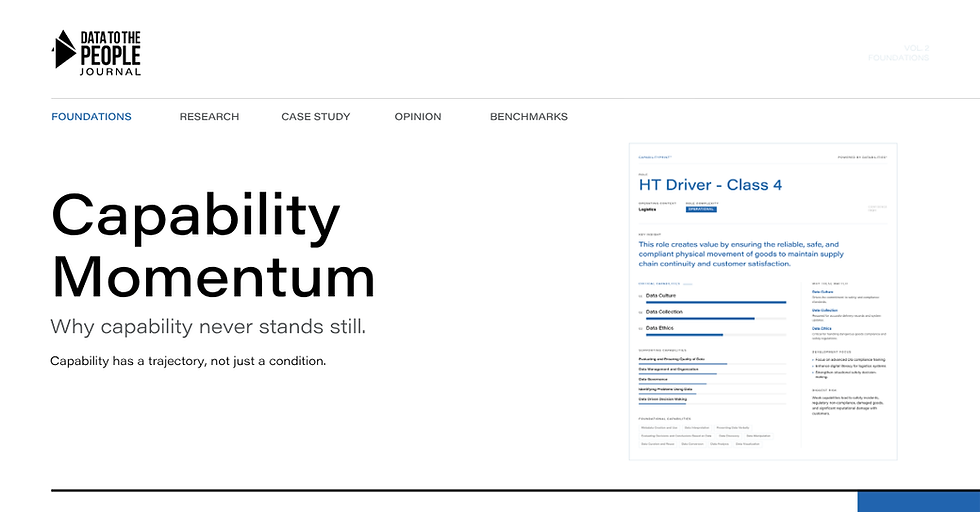
CapabilityPrint™ is a tool that measures workforce capability in data and AI. It assesses the skills, knowledge, and experience of your people to create a detailed capability profile. This profile helps you identify gaps and strengths at individual, team, and organizational levels.
By using CapabilityPrint™, you can:
Get a clear, data-driven view of your workforce’s data and AI capabilities.
Prioritize development efforts where they will have the most impact.
Track progress over time with repeat assessments.
Learn more about CapabilityPrint™ here.
Databilities®
Databilities® is a framework that defines the specific capabilities needed for data and AI roles. It breaks down complex skills into measurable components, making it easier to assess and develop workforce capability.
Using Databilities®, you can:
Align your workforce development with industry standards.
Create targeted learning paths based on capability gaps.
Benchmark your workforce against global data and AI capability standards.
Explore Databilities® here.
Benchmarking
Benchmarking compares your workforce capability against other organizations or industry standards. It provides context to your capability data, showing where you lead or lag behind peers.
Benchmarking helps you:
Understand competitive positioning in workforce capability.
Set realistic goals for capability development.
Make informed investment decisions based on evidence.
Data To The People offers global benchmarking services that integrate with CapabilityPrint™ and Databilities® to provide comprehensive insights.
Why Capability Intelligence Matters for Your Organization
Capability Intelligence provides several benefits that traditional approaches cannot match:
Better decision-making: You get clear evidence of where to invest in workforce development.
Improved alignment: Capability data links directly to business goals and priorities.
Increased agility: You can quickly identify and respond to capability gaps as business needs change.
Stronger competitive position: Benchmarking shows how your workforce compares to others.
More effective learning: Development efforts focus on real capability gaps, not just course completions.
For enterprise executives and HR or L&D leaders, these benefits translate into stronger workforce performance and better business outcomes.
How to Start Using Capability Intelligence
If you want to adopt Capability Intelligence, consider these steps:
Assess your current approach: Review how you currently measure and develop workforce capability.
Choose the right tools: Look for solutions like CapabilityPrint™ and Databilities® that provide data-driven insights.
Integrate data sources: Combine assessment, performance, and business data for a full picture.
Benchmark your workforce: Use external data to understand your position.
Prioritize development: Focus on closing the most critical capability gaps.
Track progress: Repeat assessments to measure improvement over time.
By following these steps, you can build a capability-driven workforce strategy that supports your organization’s goals.
Capability Intelligence is a practical, evidence-based approach to workforce capability. It moves beyond traditional skills lists and training records to provide a clear, actionable picture of what your workforce can do and what it needs to improve. Tools like CapabilityPrint™, Databilities®, and benchmarking make it possible to apply this approach effectively.
By adopting Capability Intelligence, you can make smarter decisions, align workforce development with business priorities, and build the capabilities that matter most. This approach helps you stay competitive in a rapidly changing world where workforce capability is a key driver of success.
For more information on how to implement Capability Intelligence in your organization, visit Data To The People.
This article is for informational purposes only and does not constitute professional advice.
Definitions on this page are based on the Capability Intelligence Reference.